The Wahl Company is still in business today. If you are a man and had a trimmer used on your hair at the barber you most likely experienced one of their products. Sadly, they do not make writing instruments anymore having sold that division to Parker in the 1950s.
A Wahl pen and friends.
Years before they were absorbed Wahl itself absorbed a firm to buttress their market leading Eversharp mechanical pencils. Boston Fountain Pen Company made good quality pens and had a few nifty patents for an inner cap and roller clip. They were always a bit short on capital, however, and Wahl knew a good thing when it saw it. After the purchase in 1917 the old Boston marked stock was used up and eventually Wahl started sticking its name on the barrels and nibs.
Wahl eyedropper pen.
So the Boston pen became the Wahl Tempoint pen. Tempoint rolls off your tongue and has a nice sound but the meaning is pretty nebulous. It’s said that it is supposed to mean “tempered point” to bring to mind flexibility and strength but in my head also conjures up the idea of “temporary point”. Anyway, the catalog of the time says the point is crafted with a special “hand hammering process” and the iridium is “fused” not “annealed” to the point for a longer life. I’m thinking if that’s the case I want to be annealed for my personal longevity.
Until the introduction of the Wahl Metal Pen these warmed over Boston pens were what was peddled. Still, they were on par with the best black hard rubber products of the time. In this post I’m showing off a simple chased BHR Tempoint eyedropper. In the 1919 catalog this model is called the “Ardmore” which may or may not be a model name. I say that since next to all the names in this book are the legend “Telegraph Word” which makes me think that these tags were used for orders via that method. One of the best things about the catalog other than the pregnant advertising prose is an illustration used a few times of a wing-collared businessman holding a pen the size of a baseball bat. It’s just superimposed over his hand and gives a certain surreal mood to the page.
Elephantitus of the pen.
My pen came to me by way of Paris a few years ago. I was lucky that the original box and instruction insert were with it which shows it’s an early model after the change in ownership since on the lid are the words “Heretofore known as the Boston Safety Pen”. Does it get quainter than that? It fills with an eyedropper which is the simplest ink reservoir system for a fountain pen. You unscrew the section and squirt ink directly into the barrel with something similar to, well, an eyedropper. The nib is a small stub which has a nice, sharp feel to it.
A "Tempoint" nib.
The other noteworthy thing about the pen is that it came with a skull clip. The French seemed to keep using aftermarket clips longer than other places and I find this one to be especially interesting. I did a blog post about it a while ago here.
So, this is a rather unremarkable but strangely satisfying pen. An eyedropper is the fountain pen stripped to the core and it’s always good to go back to basics.
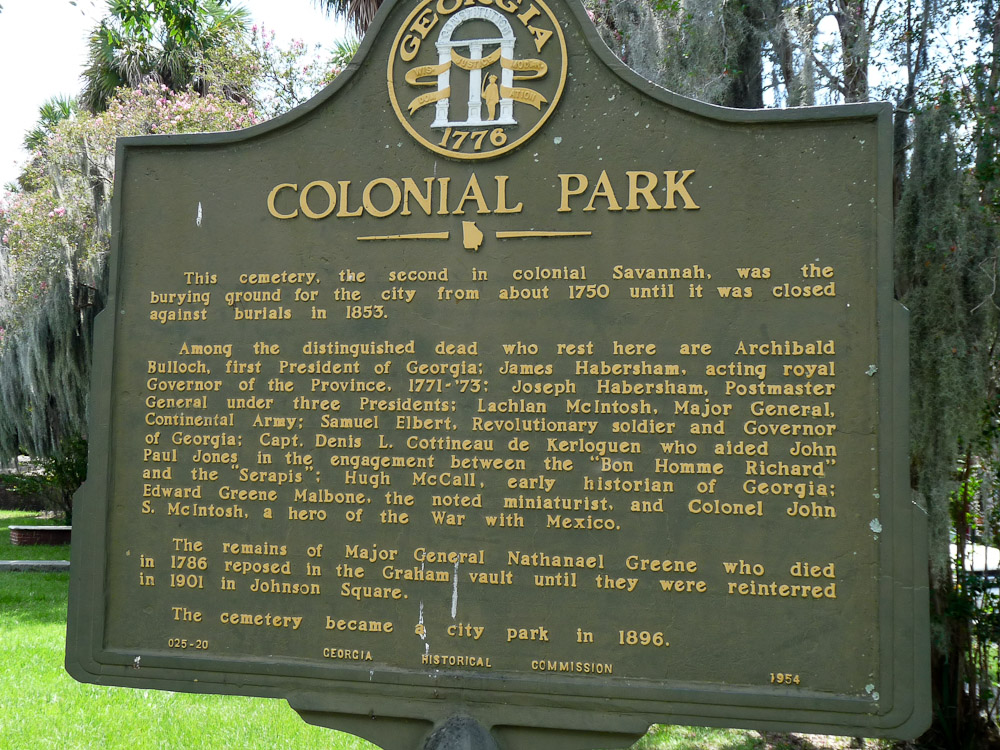
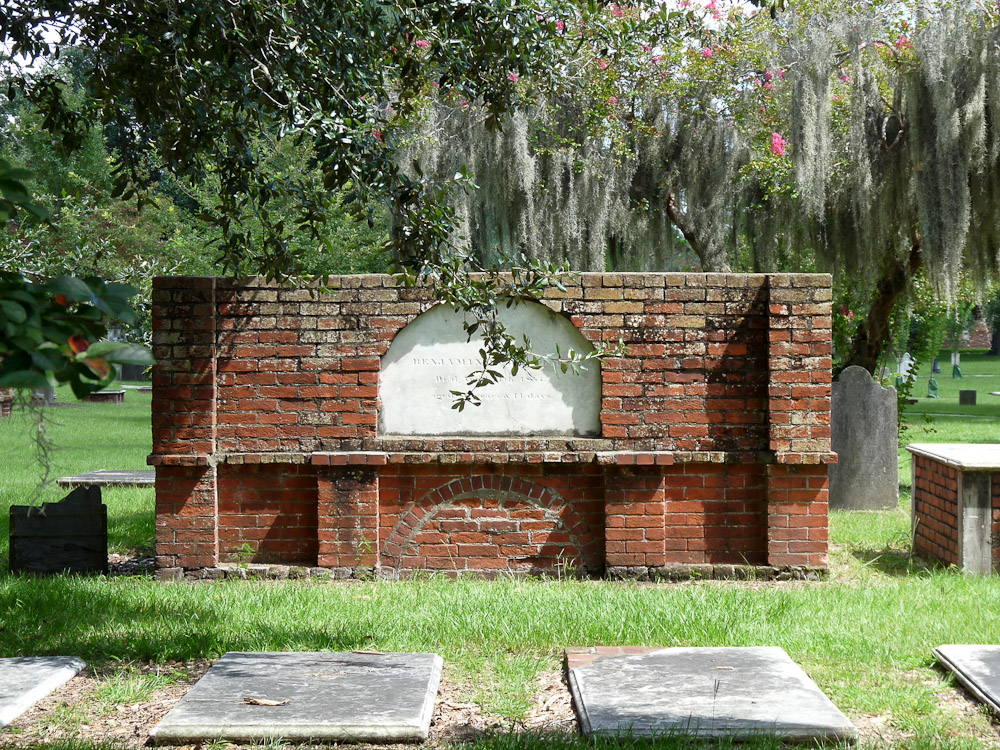
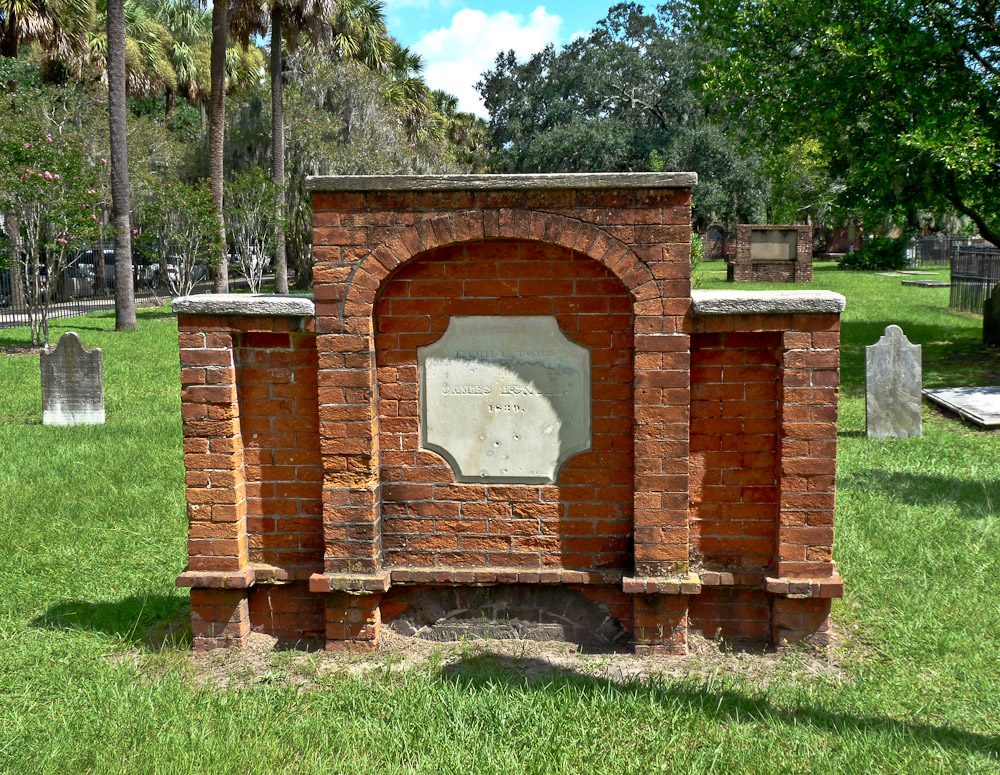
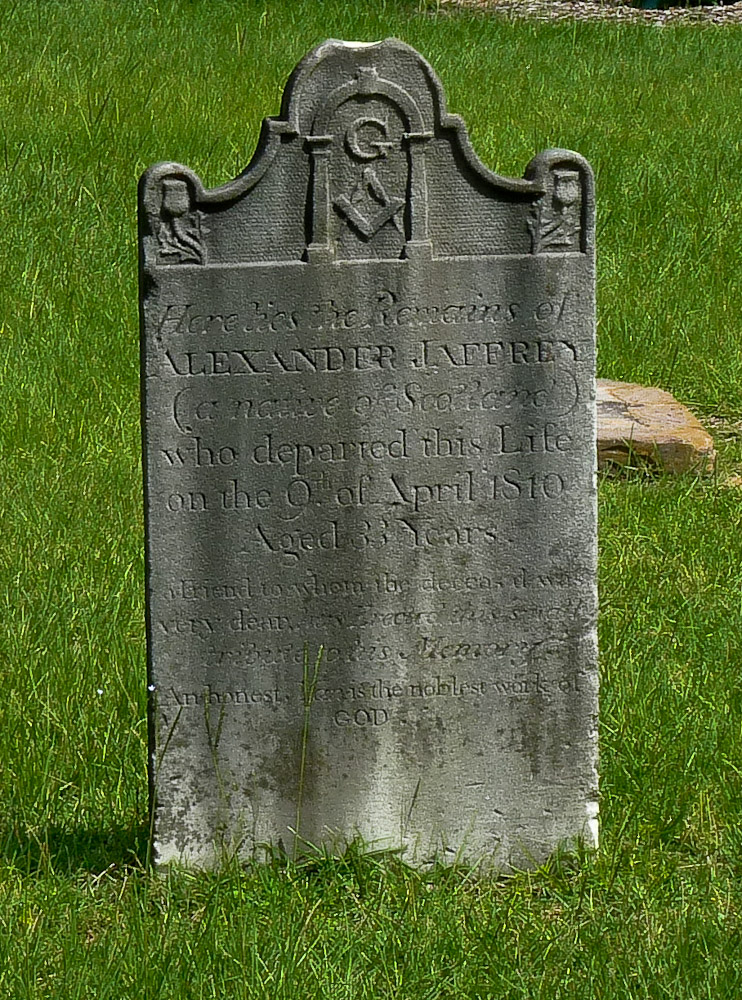
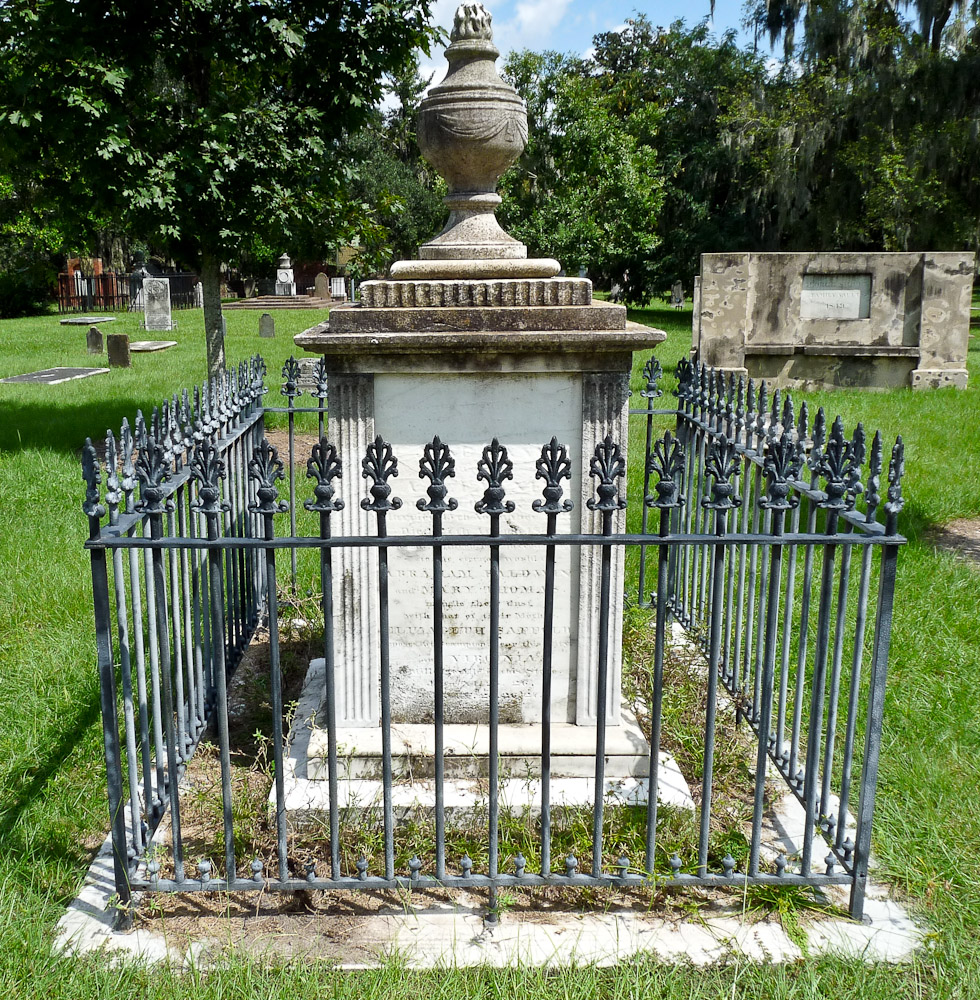
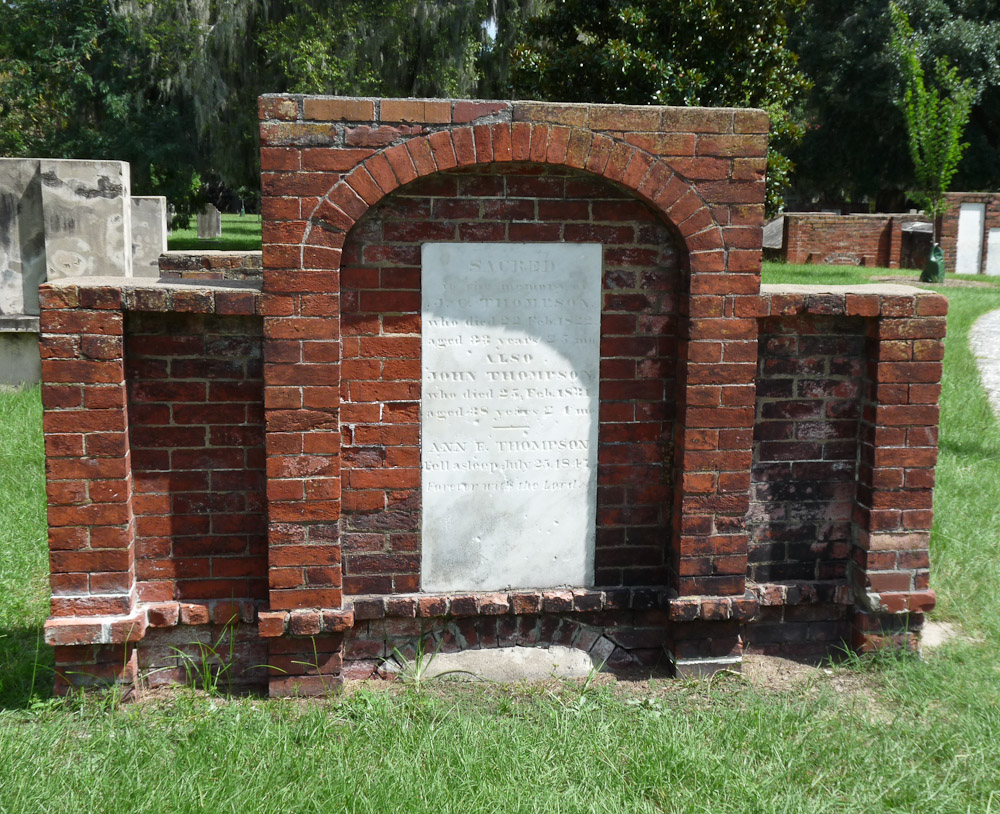
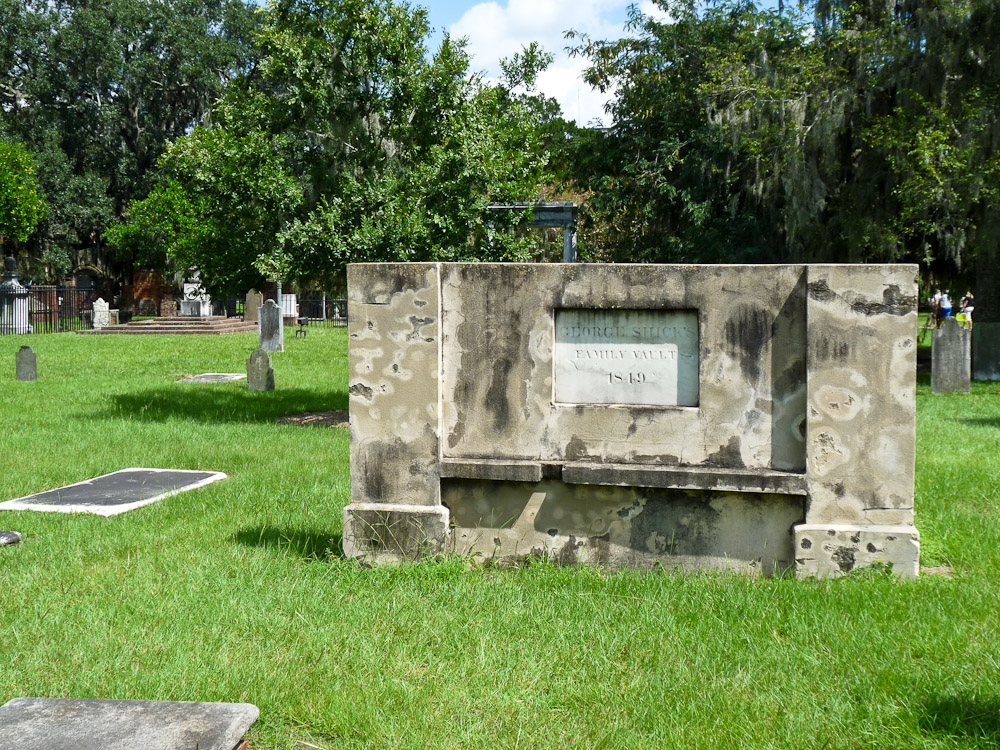
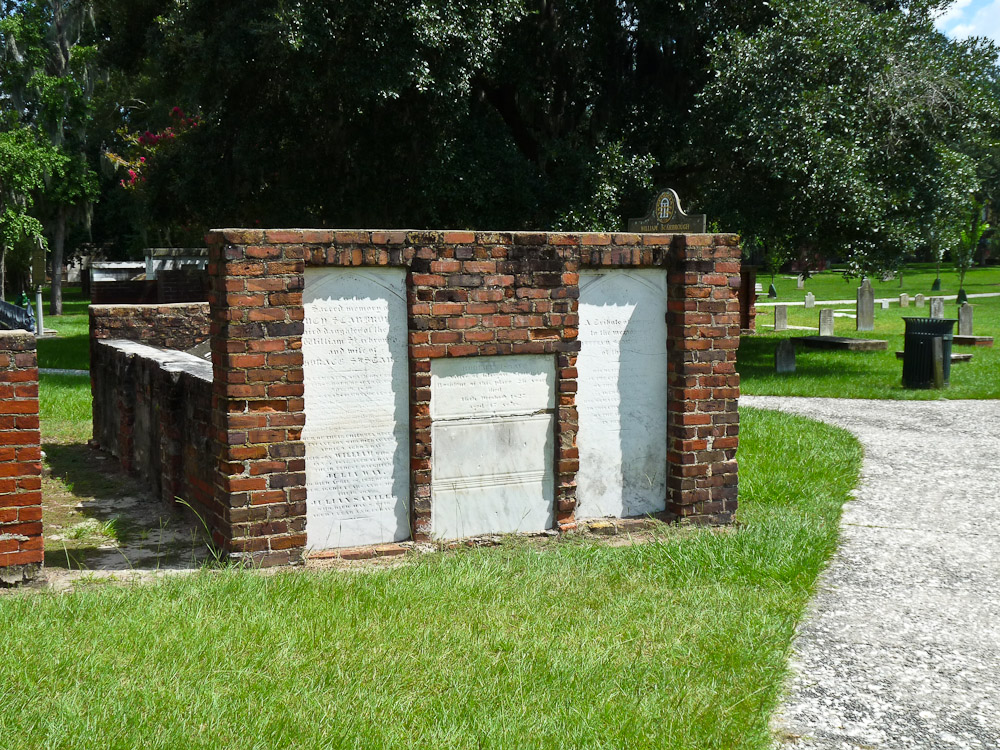
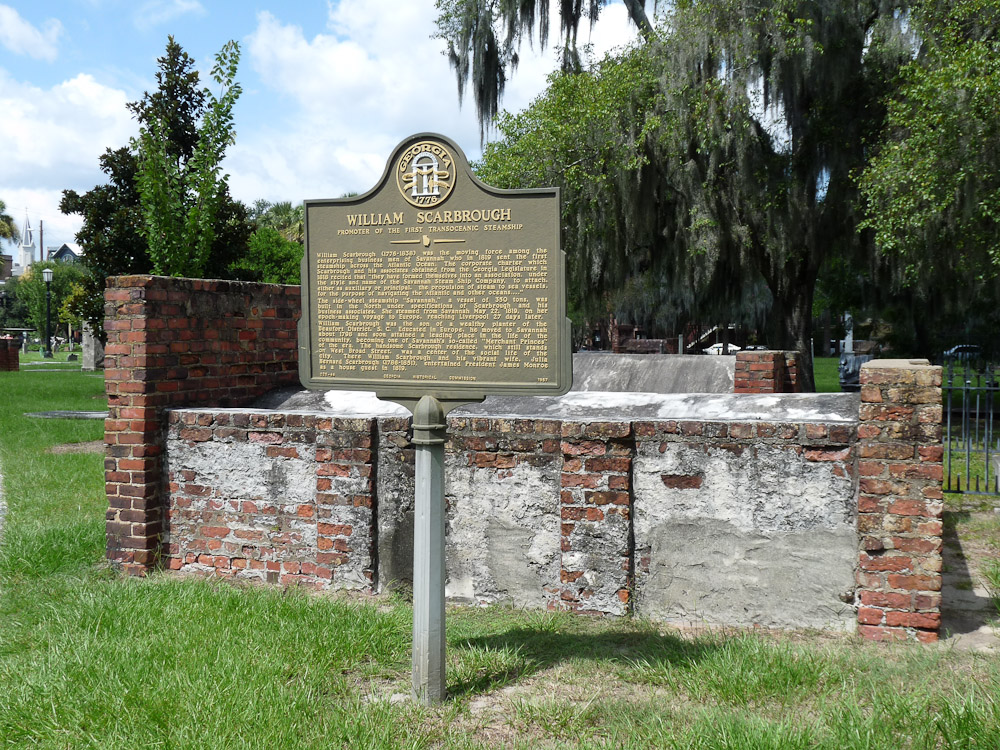
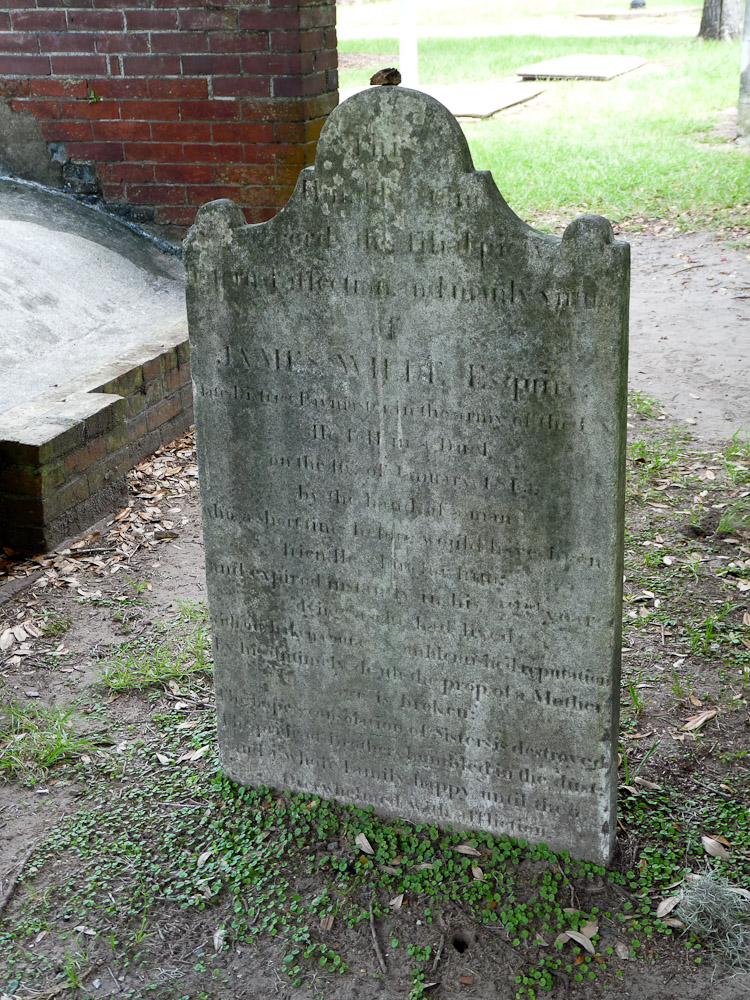
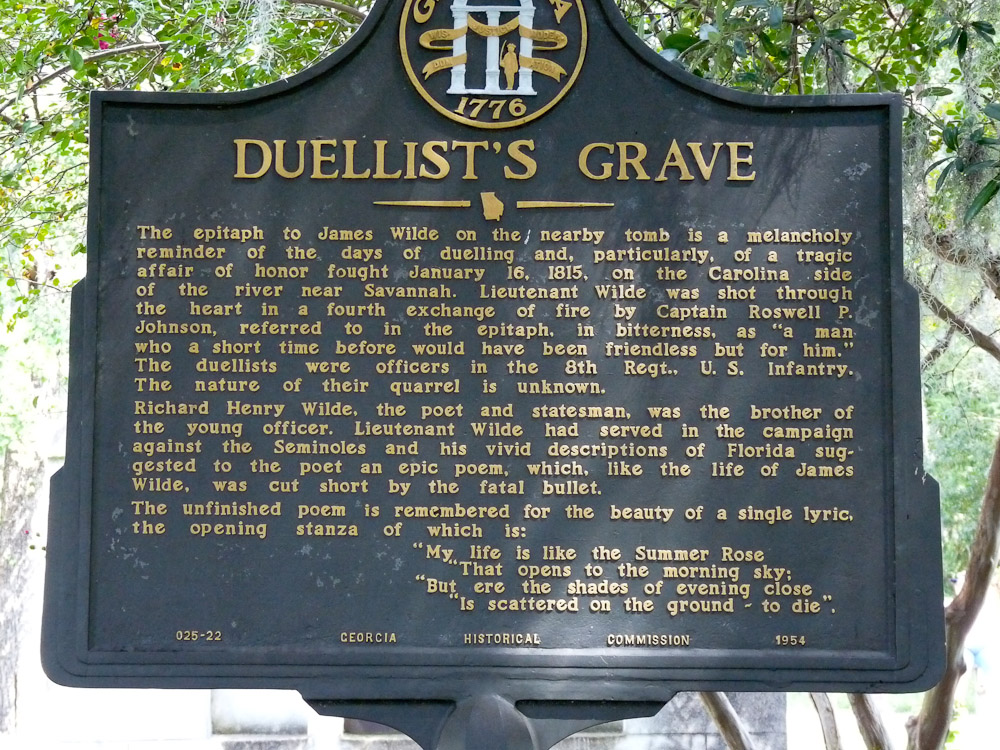
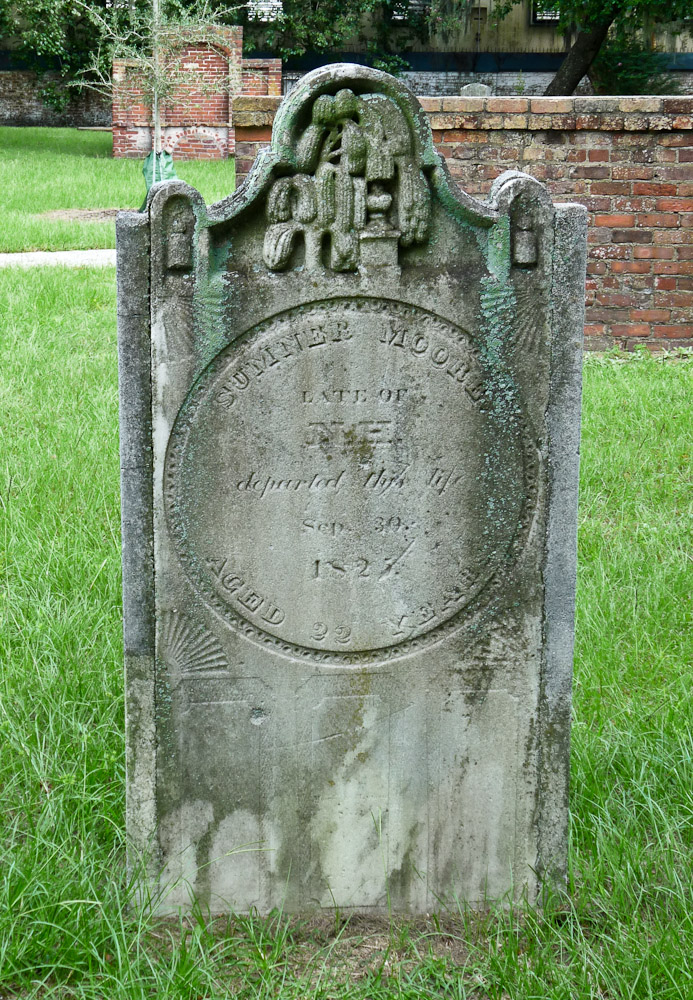
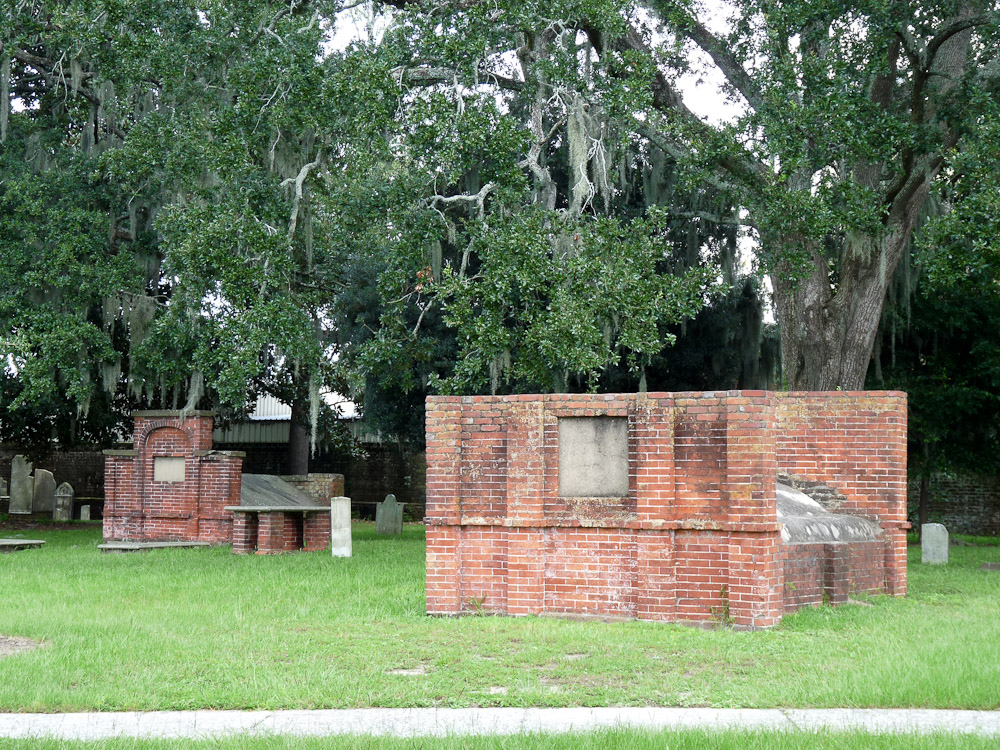
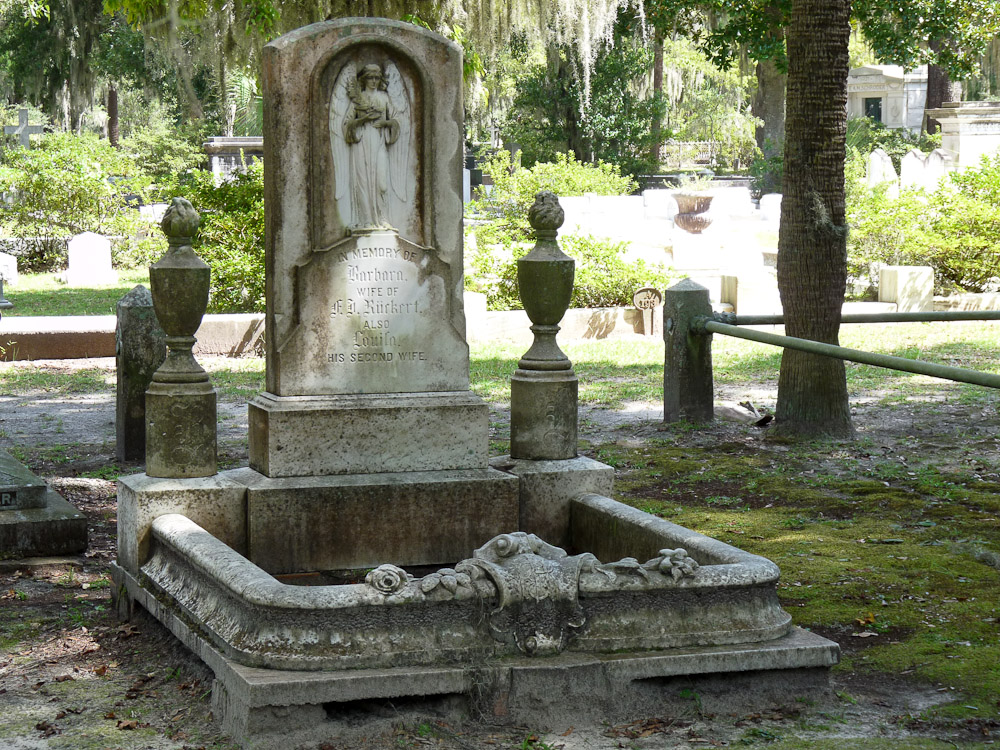
Here is another recycled bit of content for my blog. The second graveyard I visited in Savannah was Colonial Park. Indeed, it is park like in a central location with people picnicking, enjoying the green space, and children frolicking in a playground at one end. It’s the oldest intact graveyard in Savannah and was operational from 1750 to 1853. Many revolutionary war era graves are here. Most of the burial vaults are also interestingly made of brick which was a more plentiful material when they were constructed than quarried stone.
"Sacred To the memory of Rosannah Millen/Wife of John Millen/Who departed this Life the 24th of Febry AD. 1810 In the 58th Year of her Age./The nist is blessed./She lived by faith. She slept in Jesus./And shall awake with joy at the resurrection/Of the just to inherit glory./This Stone tells where reposes the remains of John Millen/Who departed this Life 28th Oct. 1811/Aged 54 years/The following lines are expressive of his Sufferings/& Expectations-/Afflictions weight I long had borne/And try’ed the healing art in vain/Till mercy whisper’d cease to mourn And death released me from my pain/Death came by sin, but even death is made/Away from pain through Christ our living head."
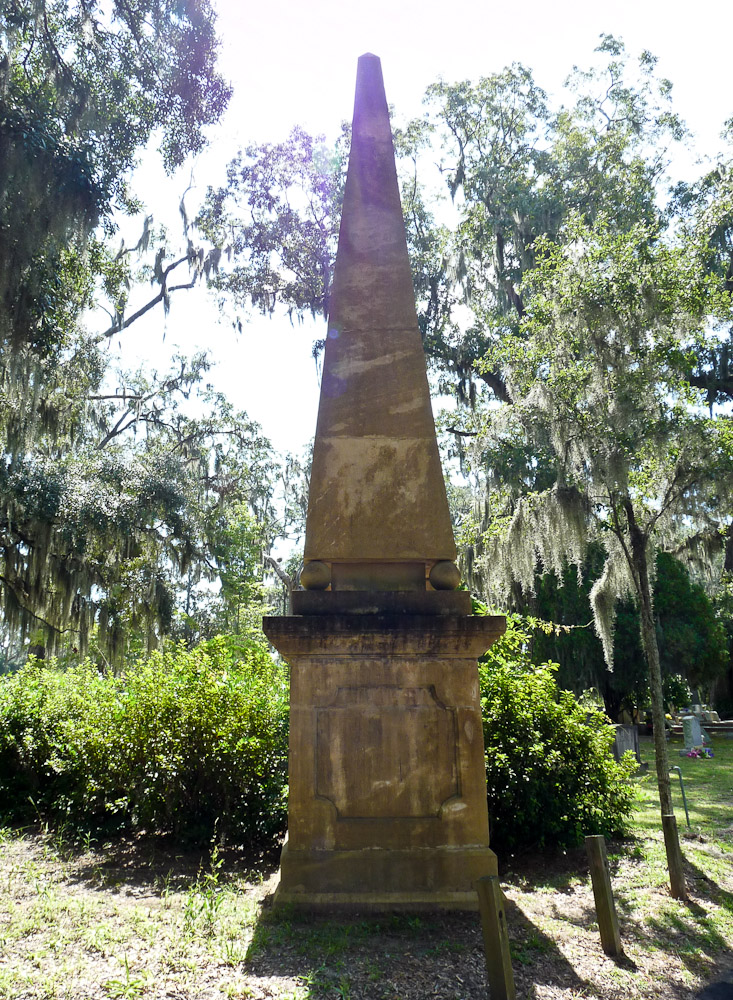
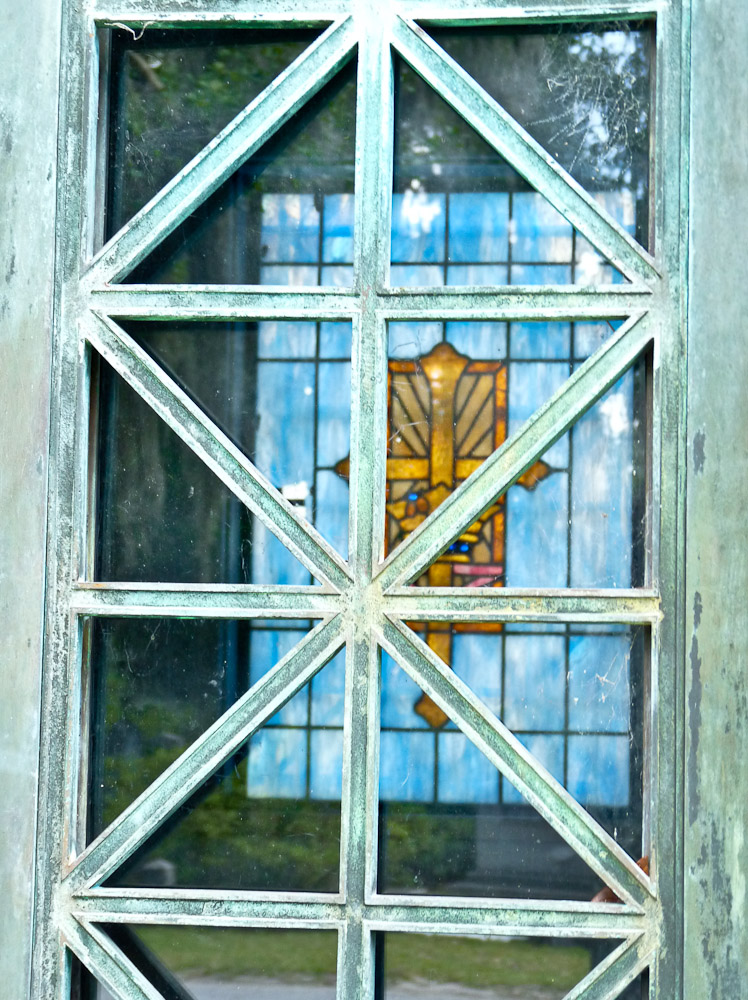
Last summer I found myself in one of my favorite places: Savannah, Georgia. An amazing amount of the historic fabric of this old merchant city remains. I love to wander through the past and one of the places I made sure to visit was Bonaventure Cemetery. Made famous by the book and movie “Midnight in the Garden of Good and Evil” the cemetery is amazingly atmospheric. With the Spanish moss, sandy lanes, and numerous impressive and disturbing memorials I could have wandered there all day. I didn’t see any ghosts but at night I’m sure memory takes foot.
I’m recycling these images for this post from a gallery I had on my Facebook account. Some recent posts by Lady Dandelion on her blog made me think of these and drag them out again.
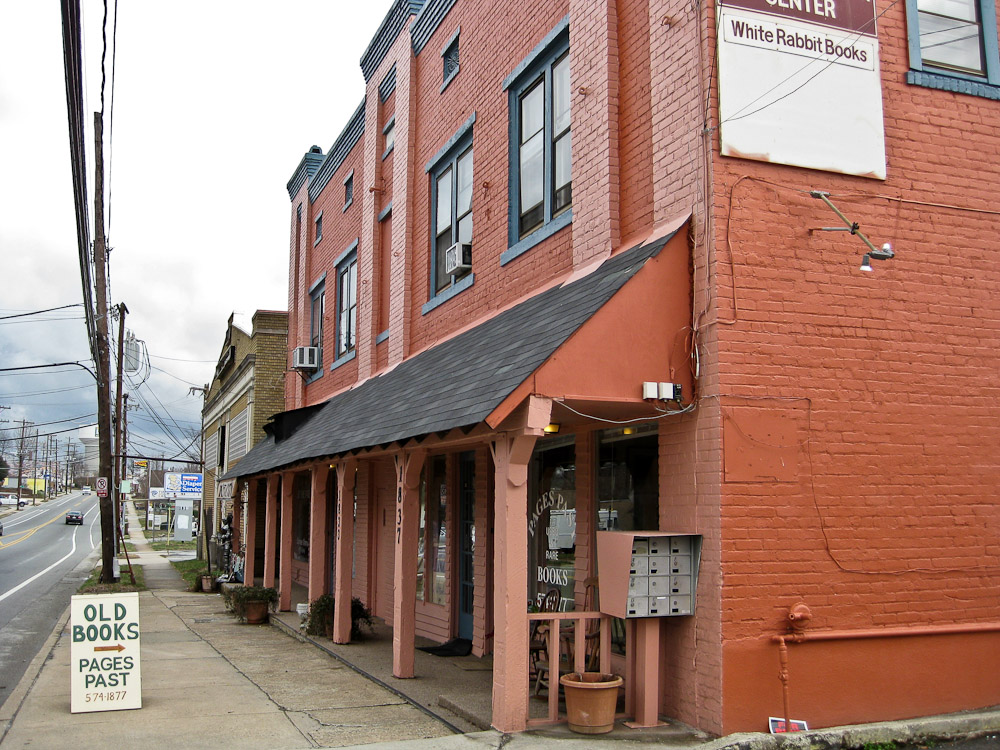
When a friend sent a link to show me a desired calligraphy pen at an online vendor I was impressed that a place with such a large stock of this specialized merchandise existed. A second surprise happened when I looked at this stores contact information and I found they were located in the city I work in. A few days later I trekked there for a look in person.
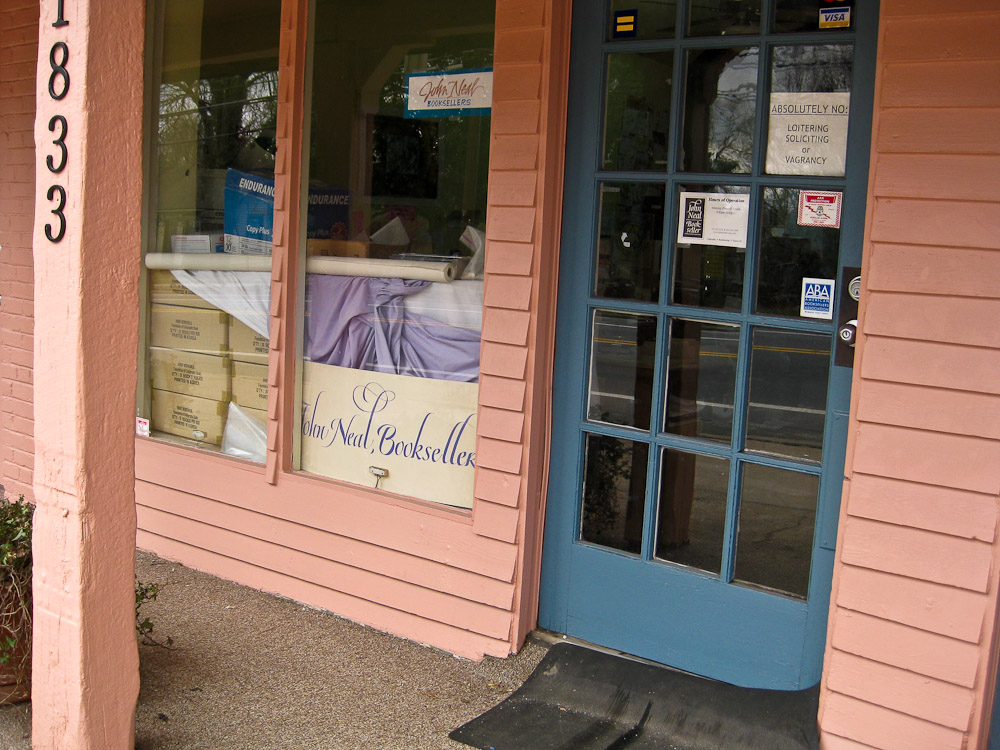
I didn’t know if they had an actual storefront so before going I checked and found reference to some clearance books being “next to the door”. That’s all I needed to see since where there’s a door there is a way in. I’ve not seen the door that can keep me out yet (unless it is locked or heavy or had a confusing latch that I couldn’t make work)!
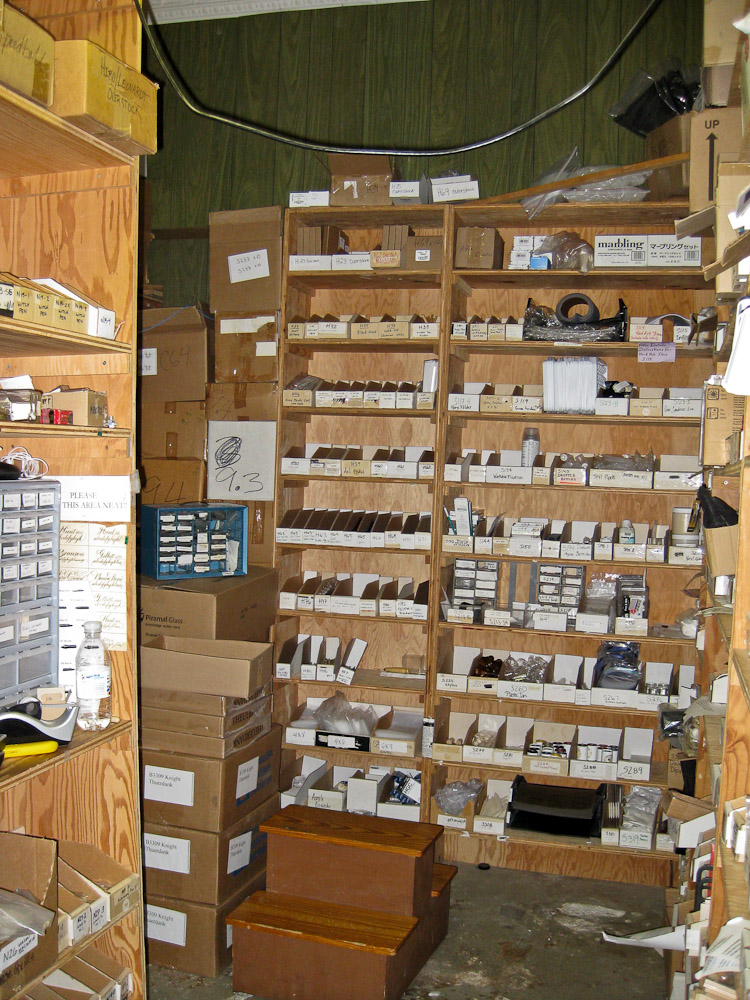
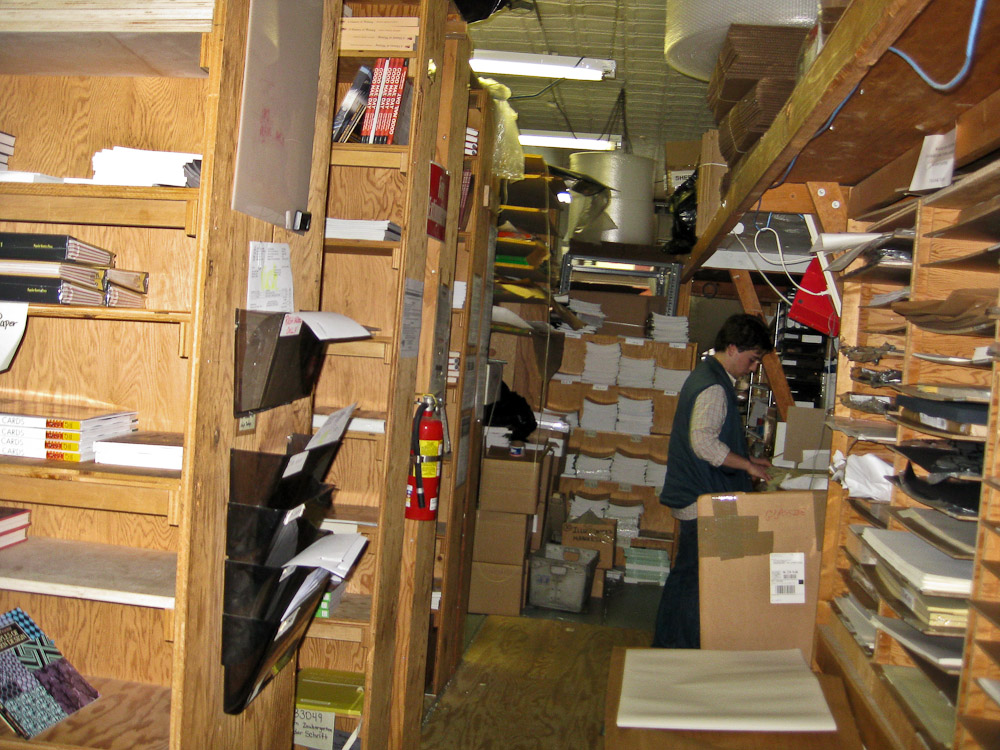
John Neal, Bookseller does sell books on drawing, calligraphy, typography, bookbinding, and more. Beyond that they carry the things you need for binding your own books and creating lovely lettering. All this is packed into a small, funky warehouse like environment that zigzags through the first floor of an old commercial building. It’s not really a “store” so to speak but they still let customers wander around and look. I had fun pulling books off of the shelves in the narrow nooks and the staff was friendly and helpful.
It’s probably more convenient to order off their web site and you are not missing out on any memorable retail experience but seeing a small, hospitable business firsthand at least made me happy. I took a few quick snapshots to share the experience and the claustrophobia with you.
I’ve been called a man out of his time. I’ve also been called “jerk face”, “loud mouth”, and “cheese baiter” but that’s neither here nor there (and I have no idea what the last one even means.) With my interests in things that are old and obsolete it’s no wonder I like the historic period that spans the gilded age through the roaring 20s. While my favorite watches were manufactured right around the turn of the century my favorite pens came into being over twenty years later.
The 1920s and 1930s are called the golden age of the fountain pen for good reason, some of the most beautiful pens ever made were created at that time. With colored hard rubber ushering out the age of the PBP (plain black pen) followed shortly after by the introduction of cellulose nitrate plastics fountain pens were now a fashion accessory. Also the teething pains of manufacture shown by awkward filling systems, strange patent feed designs, and clip on pocket clips were long in the past. Fountain pens wrote well, looked good, and didn’t leak all over your shirt pocket.
In the period between the reign of vulcanized rubber pens and the usurpers made of flammable plastic there was a time where you could get something utterly different than either material. I don’t mean the metal overlay designs had been around from the earliest days of internal reservoir pens as these were basically a hard rubber pen covered with a shell of decorative metal. While pretty they were structurally the same old pens with fancy wrappers.
Wahl, a company well known for its adding machines and Eversharp mechanical pencils, purchased the Boston Fountain Pen Company (or at least part of it) in 1917 so it could get a quick start in the business of making fountain pens. Wahl sold what was basically a slightly upgraded Boston hard rubber model for several years. Then something so big, so important, so game-changing happened that only the fine copywriters at Wahl’s ad agency could put this portentous event into words of the magnitude needed. I cannot improve on them so I will just reproduce them from the 1925 catalog here:
THE WAHL PEN OF PRECIOUS METAL: A new landmark in fountain pen progress
Along the highway of fountain pen progress are but a few landmarks denoting basic developments in design that have guided the manufacturing effort of the future. The self-filling pen was one of these.
The self-filling pen, however, required a soft rubber ink sac which occupied a large part of the hard rubber barrel, and thus left little space for ink. Because the tradition of long years demanded that the barrel be made of hard rubber, the next step was simply to increase the size of the pen to get a larger space for the ink sac.
Thus resulted the bulky pens that have been the vogue for several years. But this method of getting greater ink capacity was a makeshift, as Wahl craftsmen realized. Why, they asked themselves, need the barrel be built of rubber at all, since the ink is contained in a soft rubber sac? Why not build the barrel of a thin strong material which would give greater ink capacity, plus added strength, without the disadvantage of cumbersome size and weight?
The answers to these questions resulted in the development of the Wahl Precious Metal Pen—a pen which we believe is destined to set up a new landmark on the highway of fountain pen progress. Gold and silver were the materials chosen to carry out this revolutionary conception of a fountain pen. New as these metals were to the art of fountain pen manufacture, they had been for many centuries the only accepted materials for the making of other high class articles of persona equipment. Since the beginning of civilization, they have been the only metals discovered (except for a few of prohibitive cost) that in their native state will maintain their outward beauty as long as any part of the material lasts.
So it was but natural that they were selected as the basic materials for The New Wahl Pen. This pen is so strong as to be practically unbreakable; it is slender and graceful, yet its ink capacity is greater than that of rubber pens twice its size; it is light in weight, perfectly balanced, unfaltering in writing performance, and has the rich beauty which can come only from fine jewelry designs engraved in gold or silver.
Some of the features are shown in the sectional view at the left. Note the thin walls, the rolled metal threads which cannot be broken, the large ink sac, the compact filling mechanism. Then turn to the pages which follow and note the beautiful jewelry designs and the graceful proportions of these pens.
Try a Wahl Pen from our stock; observe its fine balance, its light weight, and its certain performance. Compare its ink capacity, if you care to, with the largest pen in your case, and prove that it holds more ink than any other.
Wahl builds rubber pens, too, for those people who are not yet converted to this modern pen. These rubber pens are the finest that can be made, and second only to the pen of the future—the Wahl Precious Metal Pen.
A Wahl #5 Metal Pen
For those other than the luddites fighting the inevitably conversion Wahl metal pens were a very nice, if not quite earthshaking, writing instrument. They came in solid gold and sterling as well as silver and gold plate. It’s common to find the gold plated or “filled” models with a good deal of brassing from their long years of service. Dents and dings are seen more often than not since these pens are made of thin metal. If you find a nice example you’ll have a good writer with reliable lever filling and nice nibs which are sometimes flexible. Even the largest metal Wahls are compact and the smaller ones are extremely tiny. Some engraved patterns are worth more than other more common ones so you might want to check out this listing of them.
The Wahl pictured here is one of the bigger models they made. Usually you can tell the dimension of the pen by the how big the nib is as indicated by a number on it. The largest is said to be a #6 but those are very rare. A #5 like this one while not common will turn up for sale every once in a while.
Eventually Wahl stopped making all metal pens and switched to a line of plastic ones. I think the fragility of these dent collecting tubes helped speed that along. So ends the tale of a pen as important as the wheel, as much a marvel as electricity, as indispensable as the air we breathe: The Wahl Metal Pen.
Music soothes the savage beast but I’m not sure it will help if this blog post makes a certain person grumpy. I must swear you all to silence after you read this just in case and I’ll tell you why later. Now that we have convened the secret order of silent pen lovers who do not rat on Tom I think I can go on and get to the subject of this post: Music nibs!
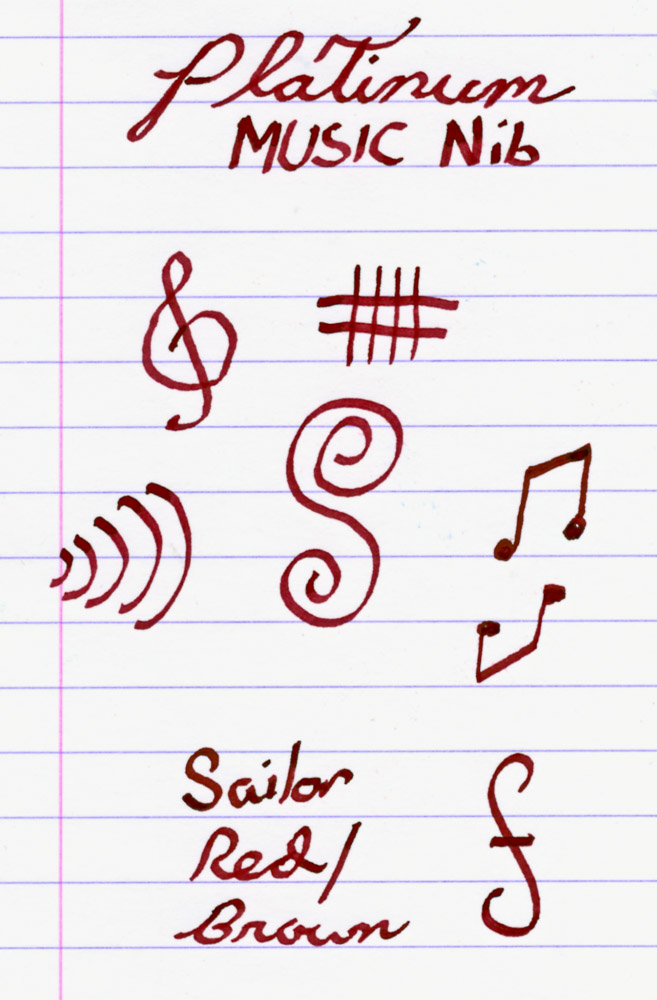
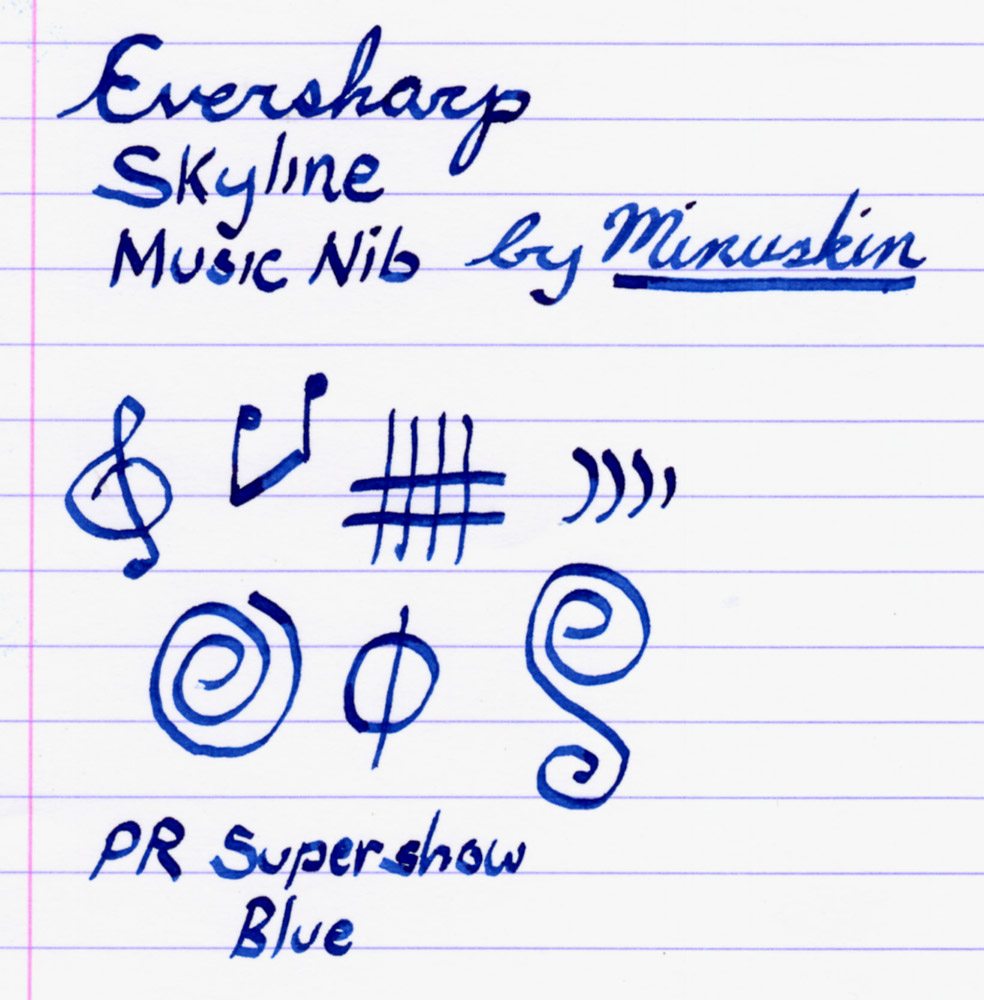
Musical notation requires very thick and very thin strokes to form all those notes, clefs, and beams. If you were writing down the score of your operatic masterpiece by hand a pen with a lot of line variation (making a thick or thin line depending on direction of movement) would be handy. Also you’d want to make sure ink flow could keep up with those wide load lines while being distributed evenly along the flat “point” of the nib. Well, in a nutshell that’s what a music nib does.
You can see how thick and thin lines are used here.
In construction this kind of nib has a broad point which is thin in section to give the necessary line widths. Yes, it looks wide enough to use for shoveling tiny, tiny snow banks. Music nibs often cause people to think they are seeing double when first encountered due to a second unique structural characteristic. In order to get more ink to the point there are two ink-conveying slits which makes the nib have three tines (the fingers in the front of the nib divided by the slit) instead of two. What you wind up with is a bit of a mutant looking nib.
The Skyline is on the left and the Platinum on the right.
I’ve got two pens with music nibs to use as examples but I know no one who can actually write music with them. The writing samples I produced are just some doodles and those mostly shows that I’m a bad doodler. I hope you get an idea of what they write like at least.
The first pen is a Platinum celluloid series pen in the koi pattern. This is a nice medium sized cartridge/converter filled pen with a single tone gold music nib. It writes a bold line and the nib requires a bit of practice to get the hang of how to hold it. I find that obtaining a music nib on a new Japanese pen is easier than purchasing one on other country’s products.
Pen number two is a Eversharp Skyline and it isn’t my pen. This is the reason is why you all need to be quiet. As a favor to a friend (Leigh Reyes) I received a pen she purchased and will forward it to her home in that far, far away land where she lives (The Philippines). This is because some folks selling pens don’t ship want to ship to far, far away places. I’m sure she’s planning to blog about this pen when it arrives and I don’t know how happy it will make her to see that I am sticking it into a post before she can. Of course what she writes about it will be better than my stuff and her writing sample will be exquisite.
The meeting of the music nibs.
Greg Minuskin created the custom nib on this Vintage Skyline, it did not come this way originally. He makes many reworked points such as stub, italic, and the music variety seen here. From a normal two-tined Skyline nib he works metal magic re-tipping the point and making three tines seemingly out of thin air. I also assume he adjusts the feed for greater flow due to the new ink monster that sits atop it.
If you are wondering how a pen with such an unusual nib writes I can tell you it does so quite nicely. The Skyline lays down a very wet line but it starts right up, doesn’t skip, and gives good feedback while gliding across the paper. It feels like the nib belongs here and isn’t an intruder forced upon the pen by some mad pen doctor.
Here are the samples I promised and pre-apologized for:
Music nibs always remind me of one of my sadder pen events. Once I had Sheaffer Snorkel with an original factory music nib. This is where I should say something about hen’s teeth but I’ll practice restraint with overused metaphors. I sold it in one of my pen purges which I have every few years when I think I need to slim down the collection. I really should have kept that one.
I hope you enjoyed the music nib mayhem. These are fun pens to write with if you want to be big and bold. Oh, if you write music you might like them too.
Here’s an update for those who entered my one year anniversary contest a little while ago. The winner, Chervatruffle, received the pen and emailed me:
“I really like the design of the body with the green bands and I like that when light shines through it the other bands are an amber color. Very nice! Writes nice too!”
The next comment after that states that her handwriting isn’t that great. I think you can see from the image below of the first sentence written with the pen that she does just fine.
I love the way this was done. The Vac is happy too, I'm sure.
Oh, the title of this post is the sentence you see above but in Tagalog. I found a site that translates it into more languages than I knew existed.
This is a post about fountain pens that click. We’re all used to some ball pens, like Parker Jotters, having a button you push to click the writing point into place but there are not many fountain pens with this tactile fun. I happen to have two of them, one well known and the other not so.
Nibs peeking out. The Aurora on the left is a hooded nib which does not retract.
I’ll start with the famous Pilot/Namiki Capless/Vanishing Point. Wow, with that many different aliases it sounds like a fugitive pen. Anyway, with those monikers Pilot is trying to hammer into your head the fact that this pen has no cap and the nib retracts into the barrel. How does that work? It’s actually pretty simple.
There is a floating nib/feed/ink reservoir unit inside that pen which can travel fore and aft. A spring keeps it up in the retracted position where it rests when not in use. A push button on the back end gets…well…pushed driving the unit forward until it is locked in place by a ratchet mechanism. Another push and the lock is released allowing the pen to close up again. The important feature that keeps the ink from drying up is a small trap door at the point end which acts as a plug when the point is retracted. QED.
There have been numerous versions of the Vanishing Point (nee Capless) since it was introduced 1964. The currently produced models come in three variants that range in heft and size. The model I have is older and dates from the 80s. I like the faceted barrel, streamlined clip, and light weight of this Capless generation. The nib on it was reground into italic creating a very fun pen to write with. It’s easy to purchase these modified nibs of this type from folks like Richard Binder or Dannzeman.
Aurora 98 in box.
The other pen in this tale is not seen as often but certainly is almost as novel. The Aurora 98 replaced the famous model 88 in 1963 and was “period modern” with a more svelte design and a few gadgets. Think of it as the Italian Parker 51 with the additional pizazz its point of origin is known for.
One of the gadgets I referred to is why this pen fits into this post: the piston filling knob extends from and retracts into the barrel with a “click”. I can’t think of a very good reason for it operating in this manner unless people in the 60s had a tendency to accidently turn the pesky exposed knob at the end of some pens. Whatever Aurora’s thinking behind this the result is pen geek cool due to unnecessary complication.
The other peculiar contraption contained within this pen is known as “Riserva Magica” (magic reserve). When you are in the dread condition of having run out of ink with this pen you can, through use of a small supplied sparkly wand, squeeze a few more lines out. Yes, I am joking about the wand. Running the piston all the way down into the barrel (like prior to filling) pushes a few trapped drops of ink into the feed. Viola! You can write a bit more.
My 98 is almost NOS and is the attractive gold filled model. It writes a lot like a Parker 51 with a firm, fine nib. The hood has an odd flat bit over the nib’s centerline which I imagine was found to be pleasing by the designer. Other foibles include a slip on cap that really needs to travel a long way down before seating and tiny, tiny ink windows which make me squint when trying to appraise the remaining fluid.
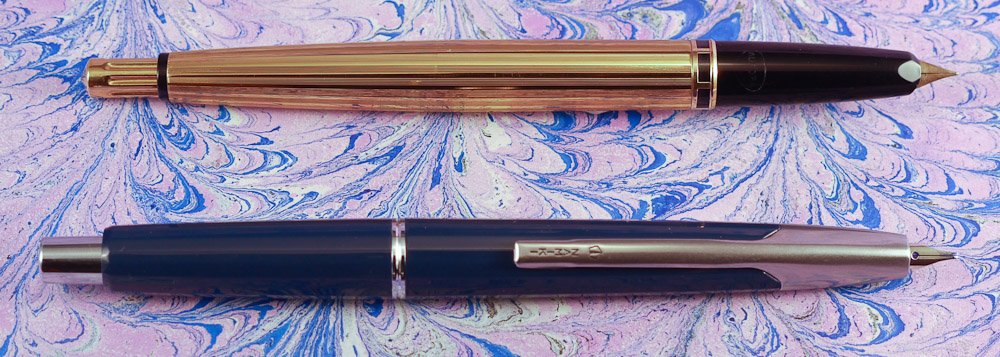
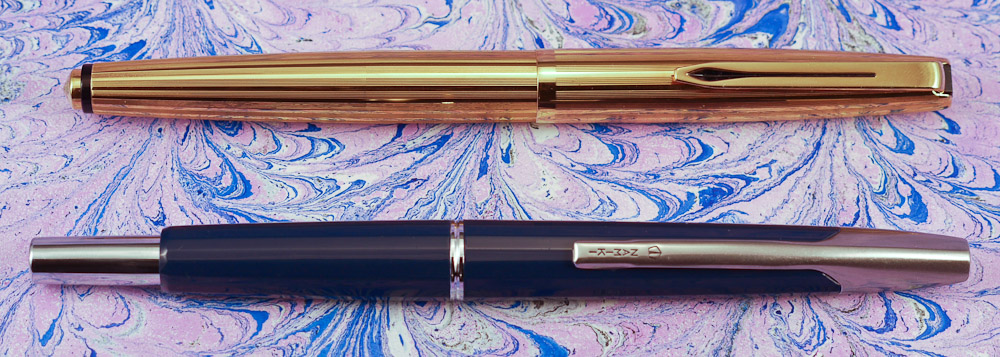
So, that’s all the pens I have with clickability. Below are a couple comparison photos of them so you can see the chic click contrivances.